

18. Pure markets

Matt Hyde is Chief Executive of the Lloyds Bank Foundation. As a guest on Ratio Talks I asked him how his childhood influenced his working life as a civil society leader. The following excerpt gives a flavour. “I was born in Ramsey, which is a small town in the Fens in Cambridgeshire. And I grew up above a family business that was established in 1876. … That upbringing was totally formative for what became my career, for what I have spent most of my life doing. … The family business was run in many ways like a social enterprise. The whole focus of it was how is the business contributing to the community. Mum and Dad were regularly volunteering. They still are in their mid-80s. And there was a sense of how businesses could be an integrated part of a community on the High Street. It was not just highly formative for me but it was for my two brothers and sister as well, who in different ways have all gone on to do roles in terms of public service. It is why I think small businesses are so important to our identity and how to get communities that come together.”

In my earlier reflection on how civil society is defined, I noted the tendency for Europeans to take a broad conception and the United Kingdom a narrow view. The broad European conception includes the market. For reason that will become clear later on in the story, I am going to use the term ‘pure market’ to delineate things like Matt Hyde’s family business from corporate business, the corner shop versus one of the big four supermarkets in the United Kingdom. The pure market encapsulates exchange of goods with and without money, including barters and loans.
I have taken my lead from Jürgen Habermas whose conception of civil society, what he calls the ‘lifeworld’, the public sphere where people talk, debate and form opinions, includes the pure market.1 At Ratio we have studied and experimented with ways in which interchanges within the pure market strengthen connection in community, build trust and generate a sense of belonging.
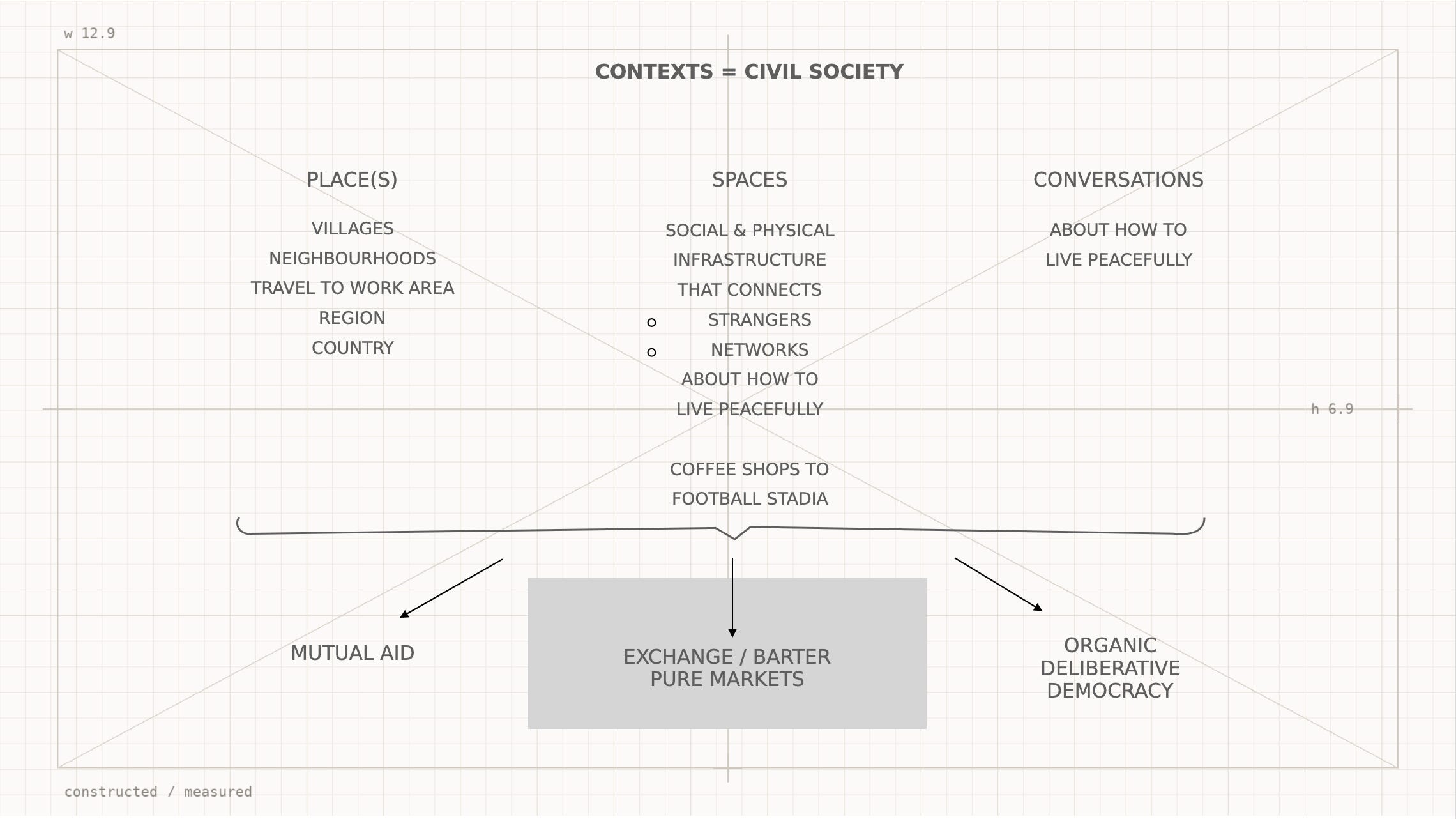
We have studied the Self-Help Group movement in India. Its founder, Aloysius Prakash Fernandez, toiled for a decade in rural Indian communities testing different ways for women to come together and take control of their lives.2 The winning formula involves 20 economically poor women from the same places but often initially strangers to each other. They save together weekly, often tiny amounts of money at the beginning. The women can make loans to each other to stimulate enterprise, for instance buying chickens to breed and/or produce eggs. After three years, the groups can take a collective loan from an Indian bank, and group members can make larger loans to each other. These small and slowly increasing financial exchanges build a strong trust bond within Self Help Groups, and a deep sense of belonging to the 200 million other members across India. This is how the Self-Help Group movement became the lynchpin of India’s anti-poverty strategy.
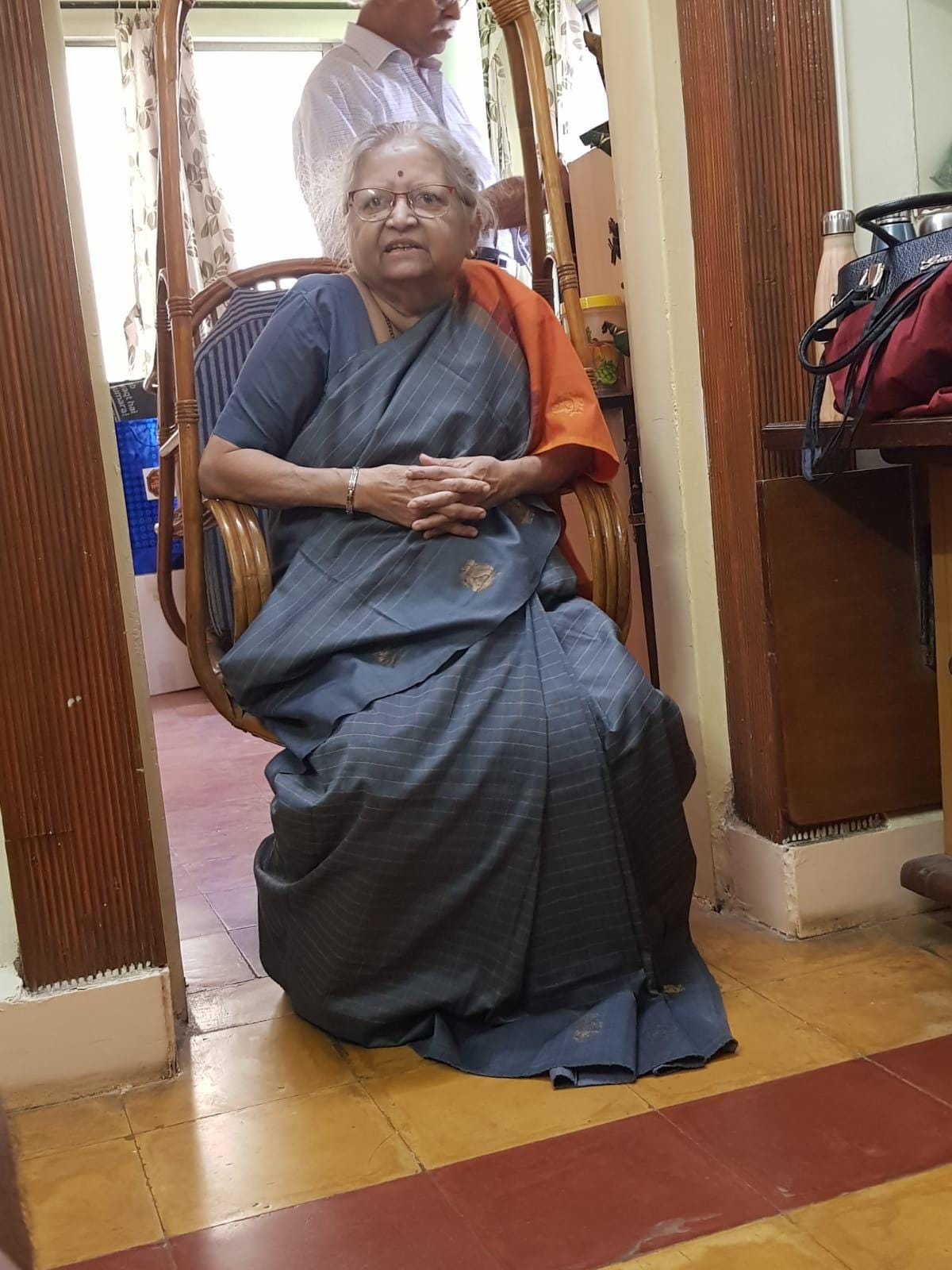
I took this picture literally sitting at the feet of Jyoti Mhapsekar at her home in Mumbai. Jyoti is one of the founders of Stree Mukti Sanghatana -roughly translated as Women’s Liberation Organisation. She was relating the story of waste pickers, women who live and work on rubbish tips, recycling the detritus of city life. They organised into Self Help Groups, building connection and trust and gradually taking control of the business of recycling in Mumbai.
Another example, this time experimental. In our work with young people, generally 12 year olds with well developed minds but limited inhibition, so they are often very creative, we have used the trust game, a product of game theorists, to demonstrate how co-operation builds trust and generates a ‘positive sum’, meaning the group as whole gains as well as individual players.3 Typically we might have six to 10 young people in a group. Each has 10 pounds in Monopoly money. Player one is invited to give some of his money to player two. The banker triples the donation of player one. Player two decides how much money to return to player one. It might be nothing, it might be whatever was shared, it might be everything player two now holds. The game proceeds with player two and three, and then three and four until everyone has had a turn. We might do this for a couple of rounds, generating winners and losers, making a note of the collective gains. Before the second iteration we talk to the young people about trust, and give them the maxim ‘Nice, Consistent, Punish, Forgive’. It asks the students to be nice; assume that the other players will be fair; to be consistent so that other players can see their strategy; to punish those who don’t return much money to them, by giving the next player less on the next round; but to forgive them in the round after that. The players apply the maxim, and when the collective pot is counted it is greater than in the first iteration. There is a positive sum. Everyone benefits.
Matt Hyde is describing a real life example of Montesquieu’s gentle commerce described earlier. Within the communicative action of quotidian financial exchanges on the High Street, within groups of women in India, and in games 12 years olds play with Ratio, connection, trust and belonging is built.
Jürgen Habermas, The Theory of Communicative Action. 1981
Aloysius Prakash Fernandez, The Myrada Experience: 50 Years of Leaning, 2018
Joyce Berg, John Dickhaut and Kevin McCabe, Trust, Reciprocity, and Social History in Games and Economic Behavior, Volume 10, Issue 1,1995