

17. Mutual Aid

Terry Conway lives in Islington North London. She was active during the pandemic, facilitating the boom in mutual aid in her neighbourhood. She spoke to me on Ratio Talks towards the end of the first lockdown in 2020. If you listen to the whole episode, you will enjoy her voice and energy as much as what she says. Here is a short except. “(There are now) a number of specific groups within the ward. So we have an indoor gardening group, we have a mask making group, we have a film club. And the most dynamic is that we have a cookery club, where people share recipes and share the stories around those recipes. Very interesting conversations about how a recipe that one person thought was unique to the culture that their family originates from, and discover that it’s actually very similar to a recipe somewhere else, and they didn’t know those connections. … At its peak, (with the local mosque) there were hot meals for 700 people on a daily basis. I think it only hit 700 for a few days, but regularly 400 plus people. And we’ve been involved in delivering that food to people, who again are those that can’t leave their homes. … But I think the whole thing about food is not just a physical thing, it’s also symbolic in a sense that for many, many individuals and many communities, the whole question of sharing food is a deep part of people’s culture. And I think that relates to what I was saying about the way our cooking club has really kind of caught people’s hearts, as well as their kind of practical resources”.
Habermas talks of communicative action. In this and the next two posts I will concentrate on the action side of communication. Specifically I will explore three activities that generate social capital and shared understanding across civil society. How these activities are done matters as much as what they achieve. Terry Conroy radiates this idea.
The first activity is mutual aid, and that takes us to the work of Peter Kropotkin.1 His 1902 book is subtitled A Factor of Evolution. Kropotkin sees co-operation as intrinsic to the human condition. His work was a corrective to Darwin and the idea of the survival of the fittest. Kropotkin is arguing that the success of most species is the product of co-operative behaviour. Once again, the ‘we’ serves the ‘I’.
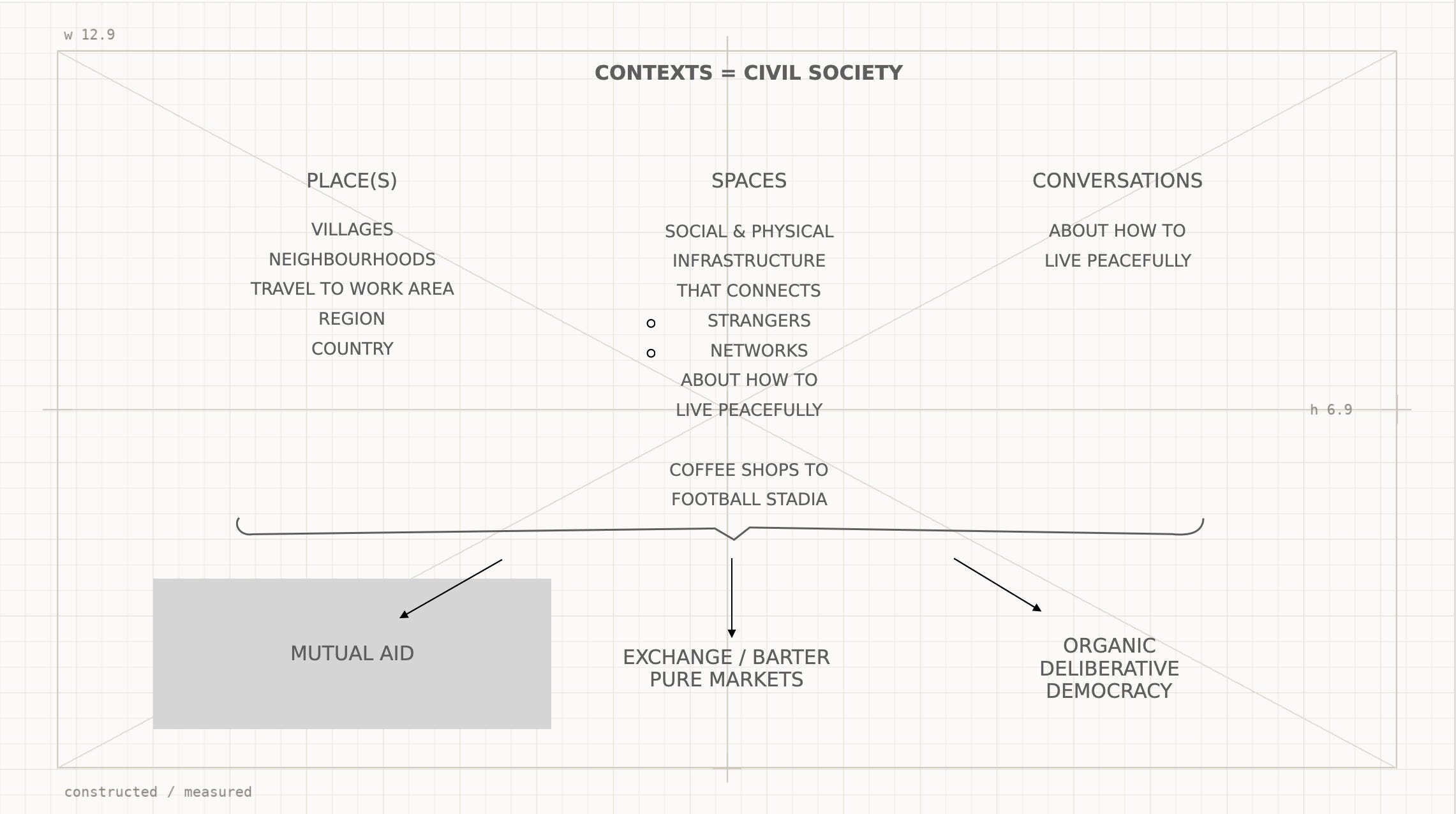
Kropotkin also reflects on the way in which the state constrains natural patterns of co-operation. His theory played out at the beginning of the pandemic. When the state stuttered, people like Terry Conroy filled the space and started to organise around voluntary action and mutual aid. To Kropotkin, things are better absent the state, hence his being a champion of anarchism (the absence of rulers).
His thinking fits with one side of two arguments about the emergence of the state that I will elaborate later on in the story. The first position best set out by Thomas Hobbes states that anarchy (the absence of rulers) led to violence and war and a life that is, in Hobbes’ famous words, “solitary, poor, nasty, brutish and short”.2 The state is the least worst alternative to this awful situation. The second position, set out by Luke Kemp, finds that pre-state anarchy was a time of egalitarianism and democracy, and that it is the state that is the source of inequality, violence and war.3 Were he alive today, Kropotkin would be very much in Kemp’s camp.
Kropotkin suggests organisms and people survive and flourish through co-operative action. Reciprocal support leads groups of people to defend and care for each other. Reviewing this evidence, my mind strayed to the work of Erik Klinenberg on living alone.4 There are two sides to his argument. One, living alone is a new phenomenon. It was extremely rare in any society prior to the 1950s. Second, people who live alone in the modern era are more social with friends and neighbours than people who co-habit. Again, co-operation seems to be part of our nature.
The phrase ‘mutual aid’ was first used by Zoologist Karl Fedorovich Kessler. Kropotkin built on Kessler’s work, noting how civil society institutions like guilds -later trade unions- clubs and associations grew out of what we might call organic co-operation.
Terry Conway’s work lies between the organic and the institutional. Mutual aid emerged between people and between organisations, informal and formal. At the time of the pandemic, there was no template to work from, but make it work they did. Terry seems to understand the ecology of her community, and the sense of meaning that residents take from mutual aid. This is communicative action in practice.
At one level, the response to Covid-19 pandemic, and especially Terry’s experience, tends to support the Kropotkin thesis. In the first lockdown, 4,000 groups involving a million people emerged. The Office for National Statistics calculated that nearly half the adult population helped someone outside of their household, up from just over one in ten prior to the pandemic. A third of people helped someone they had not previously met. This behaviour bled into the recovery of social norms around neighbourliness.
That said, the Bennett Institute published good research that reveals the response to be uneven, at least with respect to formal, named groups, often underpinned by social media on which good data are available. (Most informal activity goes unmeasured).
Peter Kropotkin, Mutual Aid: A Factor of Evolution, 1902
Thomas Hobbes, Leviathan, 1651
Luke Kemp, Goliath’s Curse, 2025
Erik Klinenberg Going Solo: The Extraordinary Rise and Surprising Appeal of Living Alone, 2012