

14. Spaces

In San Sebastián Spain, a city of 200,000 people, there are around 100 sociedades gastronomicos -or Txokos in Basque- with roughly 10,000 members. They are a space for men to come together and cook for each other. Their origins in the 19th century are disputed. Some refer to the strict opening and closing times of bars, others to men’s need for refuge from matriarchal Basque society, and some to women’s need for refuge from their men. The sociedades are often hidden away in a basement. They operate simple rules that establish and maintain trust, for example an honour payment system. During the Franco dictatorship they were a safe space to resist the state, and the men would speak -and therefore sustain- the proscribed Basque tongue. The sociedades are gradually evolving to integrate women and children.
Places connect many tens or hundreds of thousands of people. They provide a sense of affinity and belonging. This connection is primarily subjective. It is in an idea in our heads, in the heads of most of the people in a place. We meet only a tiny proportion of the people who live in ‘our’ places.
The function of face to face contact is delivered by multiple spaces that both bring together people who already know each other and, fundamental to an effective civil society, they connect strangers.
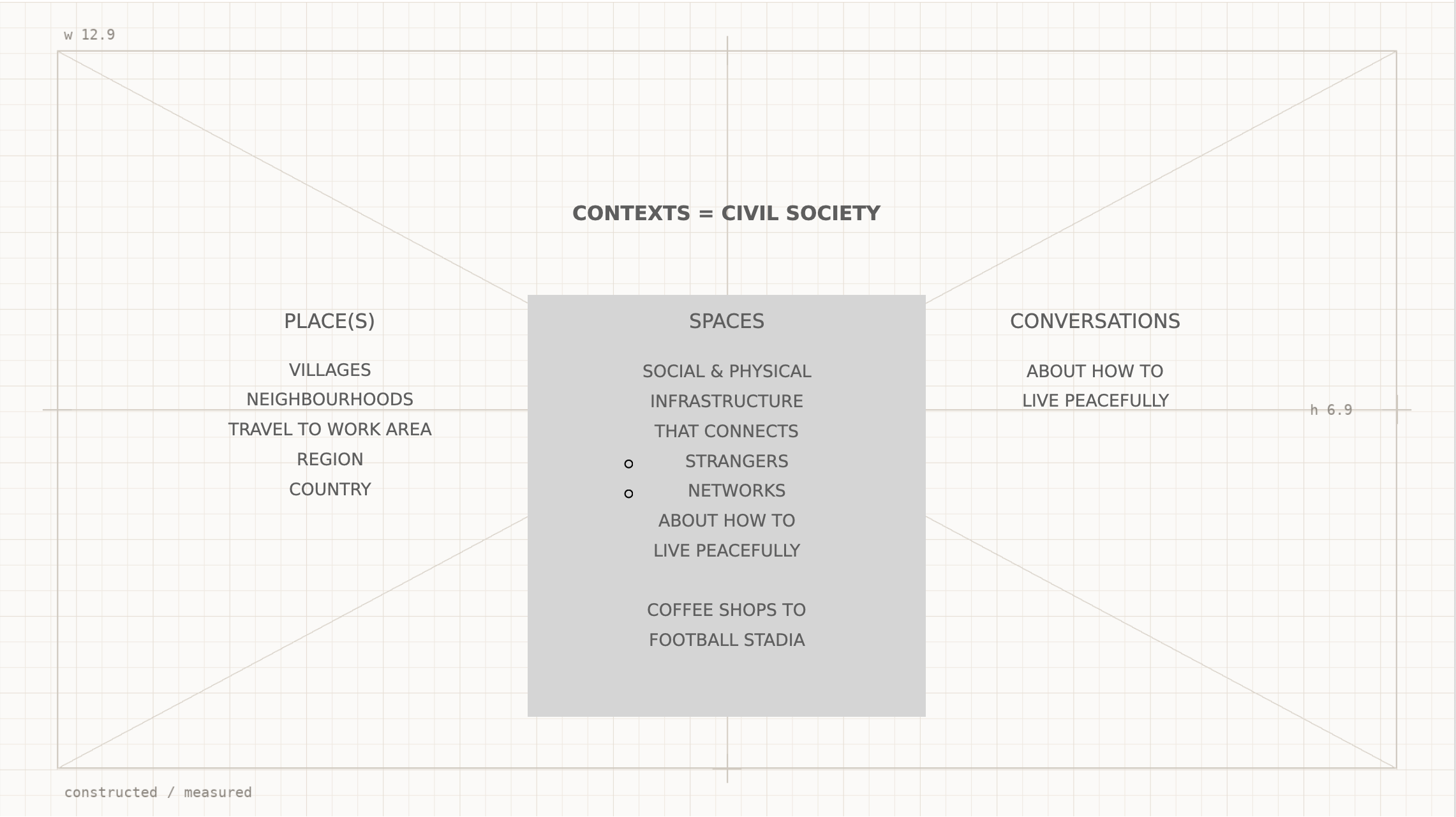
Social infrastructure again provides the frame. Ray Oldenburg wrote extensively about ‘third spaces’ between work and home such as coffee shops and pubs but also parks and civic buildings like libraries and leisure centres.1 Some connecting spaces are large, like the local football stadium, some are small -most of the 40,000 football clubs in England. Many like the Basque Txokos and community centres are organised, others, parents gathering at the school gates for example, are entirely ad hoc.
Oldenburg notes that third spaces don’t restrict agency. People are free to come and go as they please. Consequently, spaces can cross socio-economic, class and ethnic boundaries. They bring together those who would not otherwise meet and, without strategy or instruction, encourage conversations about subjects many might otherwise have avoided.
The French philosopher Montesquieu popularised the theory of gentle commerce to explain the expansion of business in the 17th Century. He found that economic growth rested not only on the self interest and competitive spirit of business people but on the co-operation and good manners required for economic exchange. All such exchanges, monetary or otherwise, require trust. I will give you this, and you will give me that. From Montesquieu’s perspective this gentle commerce shapes moral behaviour. Market interactions produce norms of reciprocity, predictable behaviour and therefore trust. All this plays out when we nip into the corner shop.
In some respects, religious institutions perfected the art of the third space. When I analyse data from Meta on social connection it appears that going to church, temple, mosque or other places of worship is the primary way of meeting new people in the United States, whereas clubs do most of the heavy lifting in the United Kingdom.
Places and third spaces stretch social connection beyond Dunbar’s number. Third spaces have three distinct qualities. One, as mentioned, the interaction is face to face. Second, the context accommodates a steady flow of strangers. Members of a Txoko generally cook with friends, but they will expect to meet new people. Third, the strangers we meet in a third space typically live nearby. We may not get to know them well, but we might expect to see them in the street from time to time.
As will be seen, the different qualities of places, spaces and other forms of social infrastructure are designed to make civil society work effectively and therefore make a significant impact on our health and well being.
Ray Oldenburg, The Great Good Place: Cafes, coffee shops, bookstores, bars, hair salons, and their hangouts at the heart of a community, 1989