

13. Place

Avril McIntyre has collaborated with Ratio for most of its existence. She lives and works in Becontree on part of an estate of 27,000 houses built between 1921 and 1935 to help clear the slums in the East End of London and support the Ford Motor plant that opened in 1931. This growth transformed Dagenham from a small town in a rural area to one of 90,000 people. Shopping centres and new transport links integrated the new neighbourhoods with the factory. High quality Neo-Georgian houses were built on Garden City principles. Avril lives in a cul-de-sac designed in 1930 to encourage community. Ford stopped building cars at Dagenham in 2002, and the main plant was dismantled in 2013. The site is now home to a new housing development contributing to Barking and Dagenham being the fastest growing of the 32 London Boroughs.
In this part of the story I will describe the function and impact of civil society, what it looks like, how it works and what it produces. I will start with form.
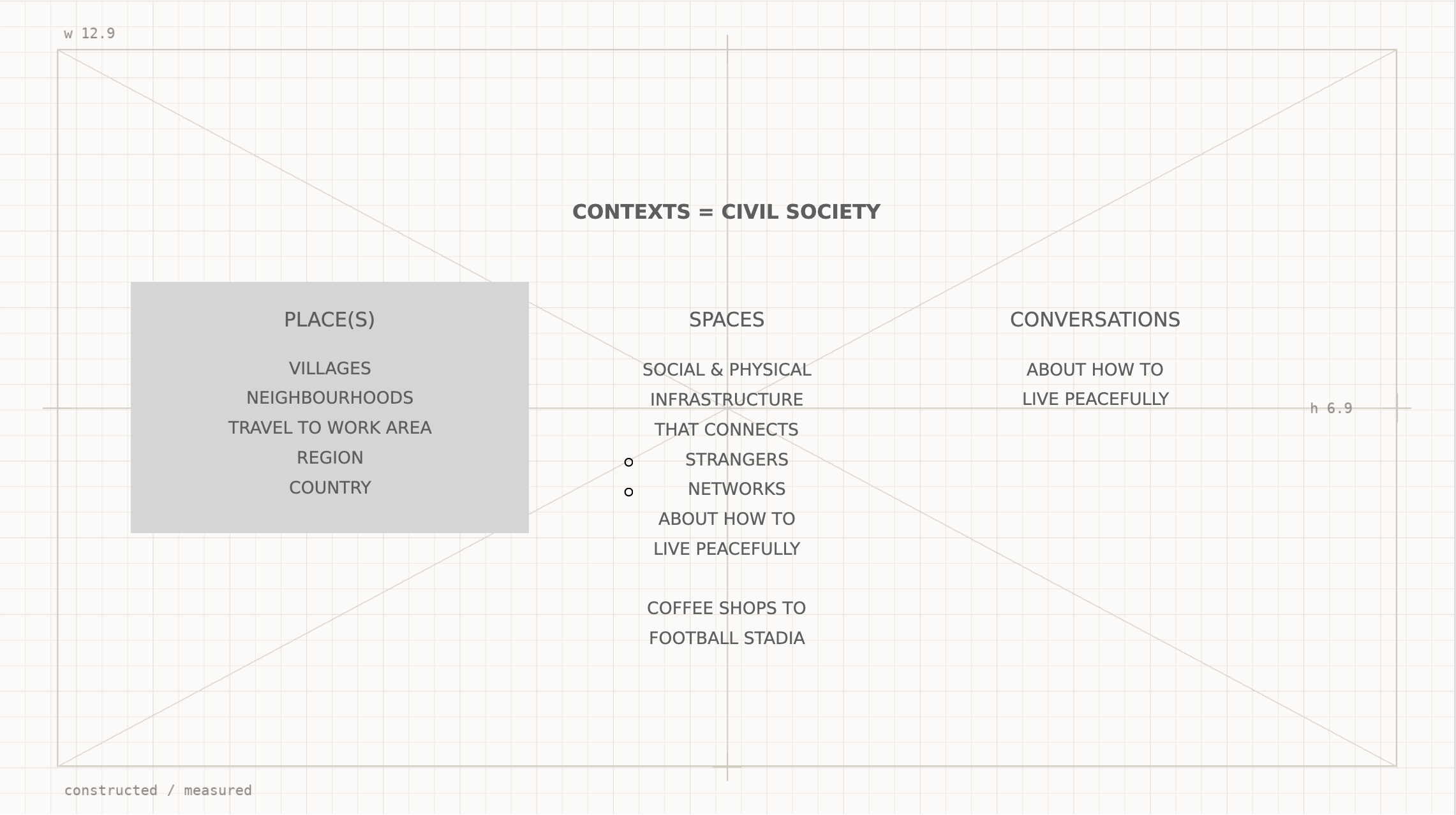
Civil society takes the form of social infrastructure, the contexts in which people connect. Much of this doubles as physical infrastructure, such as housing, factories, offices and transport links that get people from A to B. All the components in the expansion and re-birth of Dagenham.
Our ancient ancestors were by necessity nomadic, moving in groups of 30 to 50 from place to place. Climate change after the Pleistocene created large swathes of fertile land and people learned to farm, and store food, and therefore settle. Places like Tell es-Sultan formed, growing from around 2,000 people 8,000 years ago to around 25,000 today. Tell es-Sultan is modern day Jericho in Palestine.
The next great shift came with the Industrial Revolution from rural to urban. Today over half the world’s population lives in cities, and the United Nations predicts the proportion to rise to over two-thirds by 2050.
Yet, as Robin Dunbar’s research shows, the basic structure and size of friendship groups has remained the same, about 150, limited by our cognitive capacity. But a person born in Tell es-Sultan today will feel a strong affinity to the six million or so people in the Palestinian diaspora. I feel some kinship to the half a million people in Liverpool, the city of my birth, a significant proportion of whom do not share my ethnicity. I am by birth English, and, despite Brexit, I remain European. This broader sense of belonging is generally to places, plural, and the social infrastructure of civil societies, plural, is a binding agent.
The social infrastructure shapes civil society. It provides continuity. (It can also resist change). Show me pictures of typical buildings in three Northern cities and I would be confident of identifying them by their architectural style. I might be able to do the same from pictures of people dressed up for an evening out. In the past, I could do it from the colour of the buses (central government and corporate colonisation has made that more difficult). In the North, listening to accents would make the task easy. The social infrastructure of place tells us where we are, and as I will argue later in the story, as a species knowing where we are is important.
Places also embrace, adapt and resist external forces. The Dagenham story reflects a mixture of global capital and state planning. Dagenham is also a working class story. The town had strong links to Ford in Halewood, Liverpool, and to other ‘motor cities’ around the United Kingdom connected, not least, by trade unions, one of the strongest of civil society institutions in the expansion years. The film Made in Dagenham about a strike by women machinists at the Ford plant is also a social history of changing cultural styles in the 1960s. And then there is religion. The Christian churches that were built in the pre-war Dagenham expansion have been supplemented, and in some cases taken over by, mosques and gurdwaras.
Places stretch civil society well beyond Dunbar’s 150. This extended ‘we’ brings extended benefits, and challenges. To some extent each place has a distinctive civil society, which is to say relationships between people and between networks of people in each place are unique. At the same time, to some extent, there is an overarching civil society shared by everyone on the planet.